The Power of Bilingual ERP Systems: Why Arabic & English Support is Crucial for GCC Schools
Published: June 16, 2026
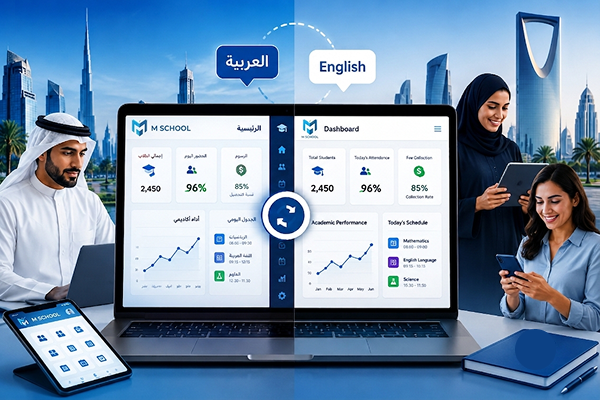
The education landscape across the GCC is evolving rapidly. As schools embrace digital
transformation, the demand for intelligent, region-focused school management solutions
continues to grow. In a multicultural environment where Arabic and English are used
equally across academic and administrative communication, bilingual ERP systems have
become an operational necessity rather than a convenience.
The education landscape across the GCC is evolving rapidly. As schools embrace digital
transformation, the demand for intelligent, region-focused school management solutions
continues to grow. In a multicultural environment where Arabic and English are used
equally across academic and administrative communication, bilingual ERP systems have
become an operational necessity rather than a convenience.
From international schools in Dubai to private institutions across Saudi Arabia, Qatar,
Oman, Bahrain, and Kuwait, educational organizations are expected to deliver seamless
communication, efficient administration, and regulatory compliance - all while serving
linguistically diverse communities.
This is where bilingual ERP systems create a measurable impact
A modern school ERP that supports both Arabic and English empowers institutions to
communicate effectively with parents, streamline internal operations, improve user
experience, and align with Ministry of Education requirements across the GCC region.
Understanding the Multilingual Reality of GCC Schools
Schools in the Gulf region operate within a uniquely diverse educational ecosystem.
Administrative teams may consist of Arabic-speaking staff, while teachers and academic
coordinators often come from international backgrounds. Parents and students may
prefer communication in either Arabic or English depending on their nationality and
educational preference
In such an environment, relying on a single-language management system can create
unnecessary friction. Language barriers can affect everything from parent communication
and fee notifications to report generation and academic coordination
A bilingual ERP system eliminates these challenges by creating a unified platform that
accommodates every stakeholder within the institution.
Strengthening Parent-School Communication
Clear communication is the foundation of a successful educational environment. Parents
today expect instant access to student information, academic updates, fee status,
attendance records, and school announcements through digital platforms.
However, communication becomes ineffective when information is delivered in a
language that some parents may not fully understand
An ERP platform with Arabic and English support ensures that parents can interact with
the school confidently in their preferred language. Whether accessing a parent portal,
reading notifications, reviewing report cards, or tracking homework assignments, bilingual
accessibility improves engagement and trust.
This not only enhances parent satisfaction but also strengthens the relationship between
schools and families.
Simplifying Ministry Compliance Across GCC Countries
Educational institutions in the GCC must comply with specific Ministry of Education
regulations, many of which require documentation and reporting in Arabic.
Schools using software that lacks proper Arabic functionality often depend on manual
translation processes, resulting in additional workload, delays, and increased chances of
errors.
A bilingual ERP system simplifies this process by enabling schools to generate reports,
certificates, and administrative documents in both Arabic and English directly from the
platform. This significantly reduces operational complexity while ensuring compliance
with local educational authorities.
For schools operating at scale, automation in bilingual reporting becomes a major
advantage.
Enhancing Efficiency for Administrative and Academic Teams
Educational institutions in the GCC must comply with specific Ministry of Education
regulations, many of which require documentation and reporting in Arabic.
When staff members struggle with language limitations within the software interface,
productivity naturally declines.
When staff members struggle with language limitations within the software interface,
productivity naturally declines.
Bilingual ERP systems create a more inclusive and efficient working environment by
allowing users to operate in the language they are most comfortable with. Administrative
staff can manage workflows more accurately, teachers can access academic tools
effortlessly, and leadership teams gain better visibility across departments.
This flexibility becomes especially valuable in international schools where multicultural
collaboration is a part of everyday operations.
Creating a Better Digital Experience for Parents and Students
Modern education is increasingly mobile-driven. Parents and students expect real-time
access to school information through apps and cloud-based portals
A bilingual digital experience ensures accessibility for all users regardless of language
preference. Features such as:
- Attendance tracking
- Timetable access
- Homework updates
- Fee payment monitoring
- Examination reports
- School announcements
- Event notifications
This accessibility improves platform adoption and encourages consistent engagement from parents and students alike.
Supporting the GCC’s Vision for Digital Education
Governments across the GCC are heavily investing in educational technology and smart
learning initiatives. Schools are expected to modernize their operations while maintaining
compliance, transparency, and service quality.
Bilingual ERP systems support this transformation by helping institutions:
- Digitize administrative workflows
- Improve operational efficiency
- Enhance communication channels
- Support multicultural learning environments
- Deliver better educational experiences
Why GCC Schools Need Region-Focused ERP Solutions
GNot all ERP systems are designed for the operational realities of GCC schools. Institutions
require platforms that understand regional compliance requirements, Arabic language
functionality, local payroll structures, and the communication expectations of multicultural
communities.
A specialized platform like M School ERP is built specifically to address these regional
needs through:
- Arabic & English interface support
- MOE-compliant reporting
- Integrated parent and student portals
- Cloud-based accessibility
- Academic and administrative automation
- GCC payroll customization
- Real-time communication tools
Conclusion
In the GCC education sector, bilingual ERP systems are no longer optional. They are a
strategic requirement for institutions aiming to improve communication, maintain
compliance, enhance operational efficiency, and support multicultural educational
environments.
As schools continue advancing toward digital transformation, investing in an Arabic and
English-enabled ERP platform provides long-term value across every level of school
management.
For educational institutions seeking a scalable and region-focused solution, M School ERP
offers the technology and flexibility needed to support the future of education in the GCC.
